Outside town the roads are faster, and mistakes cost more. This chapter covers checking the car before you leave, choosing a safe speed, bends, the three-second rule, roadworks, joining and leaving main roads, overtaking, motorway driving and lane discipline, and finally dirt roads and off-road driving.
About 30 minutes
12 sections
Handbook Chapter 3, pp. 52–71
Chapter 3 · 12 sections
After this chapter you can
Choose a speed that lets you stop within the road you can see to be clear.
Explain speed blindness and tunnel vision, and how to counter each.
Use the three-second rule to judge your following distance.
Carry out an overtake in the handbook’s order, and know when overtaking is prohibited.
Join and leave a motorway correctly using the slip road.
Keep lane discipline: drive on the right and use the left lane for overtaking only.
List the main precautions for dirt roads and off-road driving.
Section 1 of 12
Safety check before setting out
Before a trip out of town, check the car systematically with the journey ahead in mind.
Source: Handbook §3.1.1, p. 52
Rule
Check the car systematically
You must be able to carry out a systematic check of your car before you set out. The check is not the same every time: it should take into account the weather, where you are going and the state of the road.
The handbook does not list the individual checks in this chapter. It points you to the driver’s manual for advice and instructions, and says you will learn how to do the check during practical training.
Take into account: the weather, your destination and the state of the road.
Advice and instructions: the driver’s manual.
How to do it: taught in practical training.
Source: Handbook §3.1.1, p. 52
Section 2 of 12
Speed when leaving town
Never drive faster than you can control and stop. Adapt to what you can see, and watch for speed blindness.
Source: Handbook §3.1.2, pp. 53–55
Rule
Only as fast as you can stop
Your speed must never exceed the speed at which you can keep safe control of the vehicle and bring it to a halt on the carriageway or hard shoulder.
In practice this means the distance you need to stop in must be clear and free of any obstacle on the road ahead, whether you can see it or should anticipate it. The handbook’s recipe for avoiding collisions is three words: anticipate, observe, adapt.
Source: Handbook §3.1.2, p. 53
Important
Check against current rules
Speed limits printed in the handbook (check current law)
The 2018 handbook prints the figures below. Speed limits are legal rules that can change, and the limit that applies to you is always the one shown on the signs for the road you are on. Treat these as the handbook’s figures, not as current law.
Maximum speed limit on major roads in the UAE: 140 km/h.
Inside the city: usually 80 km/h.
Outside built-up areas: standard limit 100 km/h.
Always adapt to local traffic conditions.
Source: Handbook §3.1.2, p. 53Legal figures as printed in October 2018; not verified against current law.
Check against current rules. This point could not be fully verified or may have changed since the 2018 handbook.
Note
Adapt your speed
A limit is not a target. Adapt your speed to the traffic, the weather, visibility, the weight of your load, the condition of your vehicle and, above all, your own abilities. Base your driving on what you see and what you know, not on what you think.
Hidden danger: you must be able to stop well before any obstacle, real or potential. Learn to predict what could be behind a parked car, a hedge or the next bend.
Driver limitations: many drivers overestimate their ability and drive too fast. That is why single-vehicle accidents are the most common type on main roads outside built-up areas.
The road: braking distance on gravel is much longer than on asphalt, and wet asphalt is more slippery than dry.
The vehicle: performance varies greatly from one car to the next. Take things easy in a borrowed vehicle you do not know.
Source: Handbook §3.1.2, p. 53
Rule
Where an appropriately low speed is required
The handbook lists places and situations where every vehicle must be driven at an appropriately low speed. They share one feature: something may appear, or your grip or view may be reduced.
In built-up areas, at pedestrian crossings and wherever pedestrians cross.
At crossroads and junctions, at sharp bends, and at the brow of a hill or wherever your view is restricted.
Where visibility is poor because of weather or light, and wherever you might be dazzled.
When meeting an oncoming vehicle on a narrow road, and on slippery roads.
Approaching a bus, tram or school transport vehicle that has stopped for passengers.
Approaching children on or beside the carriageway, or animals on the road ahead.
At road works and at the scene of an accident.
When the surface is muddy and you might splash pedestrians or other road users.
Source: Handbook §3.1.2, p. 54
Definition
Speed blindness
Speed blindness means losing your sense of speed after getting used to driving fast. When you slow to 60 km/h after a motorway, the car feels almost at a standstill. The speedometer is very seldom wrong; your judgement is.
It is dangerous first of all because you misjudge your braking distance. Unless you keep an eye on the speedometer you can easily be travelling 20 to 30 km/h faster than you think.
A car doing 60 km/h on a dry road needs about 35 metres to stop.
At 120 km/h it needs about 110 metres.
Causes: modern cars are smooth and quiet at speed, and straight, well-made roads give the eye little variation.
Whenever you accelerate, think about your stopping distance.
Source: Handbook §3.1.2, p. 55
Section 3 of 12
Tunnel vision, bends and skidding
Speed narrows what you see. Slow down before a bend, not in it.
Source: Handbook §3.1.2, pp. 56–57
Definition
Tunnel vision
Tunnel vision is the narrowing of your visual field as speed increases. The faster you drive, the further ahead you fix your gaze, so you only take in a small part of your field of view and miss things off to one side.
To avoid it, adapt your speed to local conditions and keep shifting your gaze. At high speed, counteract it by scanning all parts of the road ahead. Stress can also cause tunnel vision or make it worse.
Source: Handbook §3.1.2, p. 56
Steps
Taking a bend
A bend can feel like a sharp corner if you arrive too fast. There are no hard and fast rules: you judge the position and speed for each bend. The right speed is the one that takes you round under full control, with the greatest safety for you, your passengers and other road users.
1Slow down before the bend: come off the accelerator and use the foot-brake progressively. Change to a lower gear if necessary.
2In the bend, use the accelerator just enough to drive the car round without going faster. That is not the same as accelerating.
3Increase speed only when you have straightened the wheel as you leave the bend.
4Speed depends on the type and condition of the road, how sharp the bend is, the camber, visibility, the weather and other traffic.
Source: Handbook §3.1.2, pp. 56–57
Important
Avoid braking in a bend
Braking on a bend can make the car unstable. The sharper the bend, the more drastic the effect and the more likely a skid. If any braking is needed, do it before the bend.
Too much acceleration is also a risk: the wheels can lose grip, particularly on rear-wheel-drive vehicles, and the car can swing off the road.
Where your view is restricted, be ready to meet oncoming vehicles, pedestrians or obstructions such as slow or broken-down vehicles with little warning.
Look well ahead for changes in the camber of the road, which could affect your control.
Source: Handbook §3.1.2, pp. 56–57
Section 4 of 12
Keeping your distance: the three-second rule
A simple count that tells you whether you are too close to the vehicle in front on a main road.
Source: Handbook §3.1.2, p. 58
Steps
How to use the three-second rule
The three-second rule is an easy way to measure your distance to the car in front on main-road driving.
1Pick an obvious reference point ahead, such as a palm tree or the shadow of a bridge.
2When the car in front passes it, start counting: one hundred and one, one hundred and two, one hundred and three.
3If you reach the point before you finish "one hundred and three", you are driving too close.
4Take your foot off the accelerator to open the gap.
Source: Handbook §3.1.2, p. 58
Example
What one second of reaction costs
When the driver ahead brakes, it normally takes you about a second to react and brake yourself. The car keeps travelling at full speed for that second.
At 60 km/h you cover 17 metres before you react.
At 80 km/h you cover 22 metres.
At 120 km/h you cover 33 metres.
Source: Handbook §3.1.2, p. 58
Note
Watch the cars further up the road
Keep your distance and scan as far ahead as you can. Concentrate mainly on the cars further up the road, which is easier if you are not driving exactly in the tracks of the vehicle in front. If that is not practical, look through the windows of the vehicles ahead.
Their brake lights give you early warning to slow down and more time to react if you have to stop suddenly. The handbook also calls the idea that driving fast saves time a misconception: it creates stress and causes many unnecessary accidents.
Source: Handbook §3.1.2, p. 58
Section 5 of 12
Road works
Slow down early and give road workers plenty of room.
Source: Handbook §3.2, p. 59
Rule
Dealing with road workers
People repairing the road work under considerable pressure. They have to concentrate on the job and watch for traffic at the same time. Show consideration: slow down in good time and keep well clear of the repair site.
Source: Handbook §3.2.1, p. 59
Steps
Ways to reduce risk on the road
In the same section the handbook lists general habits that lower your risk.
1Keep a sufficient distance from the vehicle ahead, and apply the three-second rule.
2If someone is driving too close behind you, take your foot off the accelerator to increase the safety margin.
3Be prepared for action: be extra alert whenever you think things could become dangerous.
4Be prepared to brake: move your foot over the brake pedal, ready to stop in the shortest possible distance.
5Adjust your distance to the vehicle ahead to suit the speed of the traffic and the state of the road.
Source: Handbook §3.2.1, p. 59
Section 6 of 12
Ordinary roads: turning onto a major road
Think about how fast main-road traffic closes on you, give way to all of it, and do not rely on another driver’s indicator.
Source: Handbook §3.3.1, p. 60
Example
How big a gap you need
Before turning onto a major road, think about the speed of the traffic on it. A car doing 80 km/h covers 22 metres a second. Moving off and turning onto the road will probably take you 5 to 6 seconds, and in that time the car closes the gap by some 120 metres.
To give the other driver plenty of time to brake, the handbook says to keep waiting at the stop line unless the oncoming car is at least 300 metres away. Often you cannot see nearly that far, especially in poor light.
Source: Handbook §3.3.1, p. 60
Rule
Give way to everything on the main road
You must give way to all vehicles on the main road. That includes a vehicle that is overtaking and is therefore temporarily on the wrong side of the centre line. Watch the traffic coming from your right as well: someone may start overtaking just as you begin your turn.
Stop and wait at the stop line until the road is free of traffic in both directions.
Source: Handbook §3.3.1, p. 60
Important
Do not trust another driver’s indicator
While you wait, a car coming from the left may be indicating right, as if to turn into your road. Do not trust it. Stay where you are until you know it is safe.
Drivers often leave their indicators on, and sometimes switch them on by accident.
A vehicle that is indicating could be hiding another vehicle behind it.
Source: Handbook §3.3.1, p. 60
Note
The hard shoulder and turbulence
The hard shoulder is primarily a safety zone: a refuge for broken-down vehicles. Use it sensibly and be aware of the risks. Never use the shoulder at night or in poor light. The handbook adds that parking is prohibited on roads outside built-up areas, and that this applies to the shoulder too.
When you overtake or pass a large lorry or bus, be prepared for turbulence, which may affect your steering.
Source: Handbook §3.3.1, p. 60
Section 7 of 12
Overtaking: judging the distance and doing it safely
Overtaking needs a calculation people are bad at. Ask the six questions, follow the three stages, and give up at the slightest doubt.
Source: Handbook §3.3.3, pp. 61–63
Note
Estimating the meeting point
Even on a straight road with excellent visibility, deciding whether you can overtake before an oncoming car arrives is hard. The handbook says the human brain is poorly equipped for the calculation. Many overtakes only succeed because the oncoming driver, or the driver being overtaken, is forced to brake or pull onto the shoulder. That is not how overtaking should be done.
The distance between you and the oncoming vehicle.
The speed of the oncoming vehicle.
The distance you need to overtake the vehicle ahead.
The point at which you will meet the oncoming vehicle.
Whether you can finish in good time before you meet it.
Source: Handbook §3.3.2, p. 61
Steps
Six questions before you overtake
Overtaking calls for good judgement and cooperation between several people. Speed differences, weak engines, distances, hidden dangers and a confused traffic picture can all cause serious errors. The speed of an oncoming vehicle is notoriously hard to judge, which makes your overtaking distance hard to judge too.
1What will I gain by overtaking?
2How far ahead can I see?
3How long will I need to overtake?
4How fast is the oncoming vehicle travelling?
5How quickly can I accelerate?
6How fast can I overtake?
Source: Handbook §3.3.3, p. 62
Illustrated
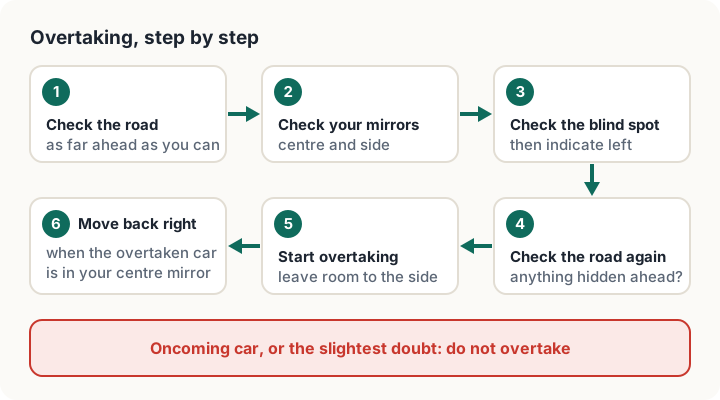
Fig. Figure 3.1The order of an overtake. Original illustration, based on Handbook Chapter 3, pp. 61, 63
The order of an overtake
The handbook’s picture sequence shows the order: road, mirrors, blind spot and indicator, road again, overtake, then back to the right once the car you passed appears in your centre mirror.
Source: Handbook Chapter 3, pp. 61, 63
Steps
Stage 1: before you pull out
The first of the three stages is all preparation.
1Check the road as far ahead as you can. The vehicle in front may be masking obstacles or other vehicles.
2Make sure you will be able to speed up enough to pass quickly and safely.
3Use your mirror and check your blind spot, in case a vehicle behind is already overtaking you. Switch on your left-hand indicator.
4Check the road once more for anything hidden further up, for example on the shoulder.
5Make sure the driver ahead does not intend to turn left.
6If there is a danger, actual or potential, flash your lights or sound your horn.
7Remember that cars may suddenly emerge from side roads.
Source: Handbook §3.3.3, p. 63
Steps
Stages 2 and 3: passing and moving back
Stage 2 is the pass itself. Stage 3 is returning to the right-hand lane.
1Overtake as quickly as you can without exceeding the speed limit.
2Leave plenty of room to the side.
3If you suddenly see a car coming the other way, or are in the slightest doubt, do not overtake, and use your right-hand indicator.
4Do not look at the other vehicle while you pass it. You may steer in the direction you are looking.
5Avoid sudden swerves.
6Stage 3: do not move back into the right-hand lane until you can see the overtaken vehicle in your central mirror.
Source: Handbook §3.3.3, p. 63
Rule
When someone overtakes you
Being overtaken is also your job to get right.
Help the other driver by keeping as far over to the right as possible.
Do not speed up. Speeding up prolongs the overtake, which creates a risk.
If things start getting dangerous, do everything you can to help the other driver.
Source: Handbook §3.3.3, p. 62
Section 8 of 12
Overtaking rules for main roads
You may overtake only when it can be done without danger. Five situations make it prohibited.
Source: Handbook §3.3.4, p. 64
Rule
When overtaking is prohibited
A driver may overtake another vehicle provided it can be done without danger. Overtaking is prohibited in each of these situations.
The lane you would use is blocked by an oncoming vehicle or some other obstacle.
On a road with only one lane in each direction, crossing the centre line is prohibited if traffic is coming the other way.
A vehicle ahead of you signals a left-hand turn or pulls over to the left.
A vehicle behind you begins to overtake.
After overtaking you would be unable to move back into the right-hand lane.
Source: Handbook §3.3.4, p. 64
Section 9 of 12
Turning off, stopping and U-turns on main roads
Prepare early, position clearly, keep your wheels straight while you wait, and stop only where it is safe.
Source: Handbook §3.3.5, pp. 64–65
Steps
Preparing to turn off a major road
Your position tells other road users what you are about to do, and keeps traffic flowing.
1Use your mirror in good time and check for traffic coming up behind.
2Give your signal, then move into the appropriate position some 300 to 400 metres before the turn.
3Turning right: move as far right as you can. It makes room for others and shows you are about to slow and turn off.
4If possible, check the blind spot with a shoulder check.
5Check the speedometer: you may have become speed-blind.
6After the turn, move into an appropriate position on the new road straight away.
Source: Handbook §3.3.5, pp. 64–65
Rule
Turning left off a main road
Before turning left it is essential to check the road in both directions. You must give way to all oncoming traffic, and the turn is only permissible if you can make it safely without obstructing oncoming traffic or vehicles coming up from behind.
Prepare in good time and take up a position close to the centre line. If traffic is coming and you are not sure you can get across in time, slow down enough to turn after it has passed.
If you need to stop, stop a few metres before the junction with your front wheels pointing straight ahead.
Why: if you were hit from behind with the wheels turned left, you could be pushed into the left-hand lane and a head-on collision.
Do not cut the corner.
Source: Handbook §3.3.5, pp. 64–65
Note
Check against current rules
Left turns and the vehicle behind (check current law)
The handbook says that about two thirds of all accidents at junctions involving left-hand turns involve vehicles coming up from behind, and that the law places sole responsibility for such accidents on the driver who attempted the turn.
This is the handbook’s 2018 description of the law. We could not check it against current law, so use it as a reason to check behind you carefully, not as a legal reference.
Source: Handbook §3.3.5, p. 64Statistic and legal statement as printed in October 2018; not verified against current law.
Check against current rules. This point could not be fully verified or may have changed since the 2018 handbook.
Rule
Lay-bys, stopping, parking and U-turns
A car parked on a main road is always a potential hazard. If you decide to stop, preferably use one of the special lay-bys or parking places spaced along the road.
If you have to stop elsewhere, pull over to the right as far as you possibly can.
If your car has broken down, set out your triangular warning sign.
The handbook notes that parking on a primary road outside a built-up area is prohibited.
Do not make a U-turn on the road unless you can see what is coming.
Any manoeuvre on a main road must be carried out without obstructing or interfering with other traffic.
Source: Handbook §3.3.6, p. 65
Section 10 of 12
Motorways: what is prohibited and how to join
Motorways are faster and statistically safer, but accidents there are more serious. Join by matching speed and giving priority.
Source: Handbook §3.4, pp. 66–67
Note
How motorways differ
Motorways are designed to let traffic travel faster and in greater safety, which puts greater demands on both driver and vehicle. Conditions change more rapidly, so you need to be alert and concentrate fully.
They have fewer accidents than other roads, but those that happen are at higher speeds and involve more vehicles, so injuries are usually more serious.
Monotony: the lack of variation makes driving monotonous and drivers get tired.
Speed blindness: you believe you are going much slower than you are, so you tend to drive too close. Speed-blind drivers are often involved in motorway pile-ups.
Source: Handbook §3.4, p. 66
Rule
Prohibited on a motorway
On a motorway it is prohibited to do any of the following.
Stop.
Park.
Reverse.
Turn around or make a U-turn.
Walk.
Cycle.
Source: Handbook §3.4, p. 66
Important
Check against current rules
Slow vehicles on motorways (check current law)
The same list in the 2018 handbook also prohibits driving a vehicle designed for speeds of less than 60 km/h on a motorway. This is a legal figure that may have changed, so check the current rule before relying on it.
Source: Handbook §3.4, p. 66Legal figure as printed in October 2018; not verified against current law.
Check against current rules. This point could not be fully verified or may have changed since the 2018 handbook.
Illustrated
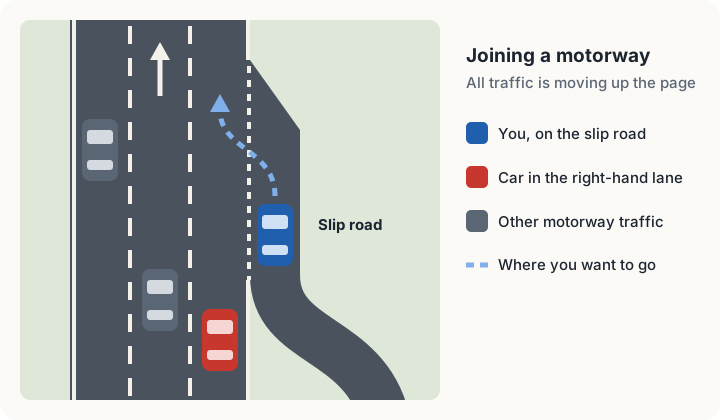
Fig. Figure 3.2Joining from the slip road. Original illustration, based on Handbook §3.4.1, p. 67
Joining from the slip road
A slip road leads you onto the motorway. Leaving the slip road is a lane change, so the responsibility for avoiding an accident is entirely yours.
Adjust your speed to that of the traffic already on the motorway before you join.
Give priority to traffic already on the motorway.
Join where there is a suitable gap in the right-hand lane.
A quick sideways glance may be needed to check where other vehicles are.
Try to avoid stopping at the end of the slip road, unless you are queuing to join other slow-moving traffic.
Source: Handbook §3.4.1, p. 67
Rule
Space on the motorway
The faster the traffic, the more time and space every action needs. Give yourself greater margins than on ordinary roads, and always make sure there is enough space between you and the vehicle ahead.
Leave a gap of at least one metre for each km/h of your speed. The three-second rule is a useful way to judge it.
Where chevrons (V-shaped spacer markings) are painted on the surface, keep at least two chevrons between you and the vehicle in front.
Tailgating, driving too close to the car in front, is very dangerous and often causes serious motorway accidents.
Source: Handbook §3.4.1, p. 67
Steps
Helping other drivers to join
After you pass an exit there is usually a slip-road entrance where other vehicles join. You should help them.
1Slow down and make space, or speed up if appropriate.
2Do not try to race them while they are on the slip road.
3Look well ahead if several vehicles are joining, and be prepared to adjust your speed.
4Move over into the left-hand lane, provided you can do so safely, to make merging easier.
Source: Handbook §3.4.1, p. 67
Section 11 of 12
Motorways: lane discipline and leaving
Drive on the right, overtake on the left and move back. Plan your exit early and never use the hard shoulder as an exit.
Source: Handbook §3.4.2, pp. 68–69
Rule
Strict lane discipline
Always be in the appropriate lane for your speed and the traffic conditions. On a two-lane motorway the correct position for normal driving is the right-hand lane. On wider motorways keep to one of the right-hand lanes unless there are many slow-moving vehicles ahead.
Poor lane discipline is one of the most common examples of thoughtless behaviour on motorways, and can contribute to accidents by forcing traffic into the outside lane.
Check the rear-view and side mirrors frequently so you always know the relative speeds of the vehicles around you.
Do not change lanes unless you need to, and avoid changing repeatedly.
Keep the car steady in the centre of the lane. Do not wander into another lane.
Source: Handbook §3.4.2, p. 68
Rule
The left lane is for overtaking only
The left-hand lane is for overtaking. Once you have overtaken, return to the right-hand lane as soon as it is safe. It is not meant to be used as a "fast lane".
You may stay in the centre or left lanes while passing a number of slower vehicles, but no longer than you have to. Do not stay in an overtaking lane longer than it takes to move out, overtake and move in again safely.
Drivers who stay in the left lane ignore faster drivers behind and force them to overtake on the wrong side.
After overtaking, return to your original lane or the appropriate lane for your destination.
Give others the chance to overtake you.
Do not block traffic that is not allowed to use the outer lane.
Source: Handbook §3.4.3, p. 68
Note
Interchanges and climbing lanes
Where motorways merge or separate, at interchanges, you may need to change lanes, sometimes more than once. Pay attention to the overhead direction signs and move into the correct lane in good time. Where hatch markings indicate splitter islands, stay in your lane.
Assess conditions well ahead and watch for other drivers changing lane. A steep hill on a motorway may have a crawler or climbing lane so that heavy vehicles do not slow the flow.
Source: Handbook §3.4.2, p. 68
Steps
Leaving a motorway
Unless you are going to the end of the motorway, you leave by an exit on the right-hand side, moving from the right-hand lane onto the slip road.
1Plan well ahead, particularly on three- or four-lane motorways, and get into the right-hand lane in plenty of time.
2Use the road signs and markers, and use your mirrors and signal in good time. There is no need to rush.
3Follow the mirror and signal routine for each change of lane.
4Do not move to the right more than one lane at a time.
5Do not cut across a lane of traffic onto the slip road, and do not cut across at the last moment.
6If you miss your exit, carry on to the next exit.
7Where an earlier exit or a service area comes just before yours, look well ahead for the advance warning signs.
Source: Handbook §3.4.4, p. 69
Important
The hard shoulder is not an exit road
You should never queue or drive on the hard shoulder. It is not an exit road. It can be used if you need to pull over in an emergency.
Source: Handbook §3.4.4, p. 69
Note
After the exit: new rules, old speed
After a while at motorway speed your judgement of speed will almost certainly be affected: 60 km/h seems more like 40 km/h. Exit roads sometimes curve sharply or are quite short, so check your speedometer every now and then, and especially as your exit comes up. It gives you your actual speed.
"End of Motorway" signs stand at all exits. They mean the road you are joining has different rules, so watch for signs telling you what they are.
As soon as the motorway becomes an ordinary arterial or main road, expect to meet oncoming traffic.
Source: Handbook §3.4.4, p. 69
Section 12 of 12
Dirt roads and off-road driving
Loose, changing surfaces need low speed and space. Off-road, never go alone.
Source: Handbook §3.5, p. 70
Rule
Dirt roads
Dirt roads are very common in the Gulf region and are not the best surface for an ordinary car. The surface is uneven, bumpy and loose, turns muddy and slippery when wet, and keeps changing as vehicles wear it.
Always expect the unexpected. Drive slowly and keep a respectable distance from other cars and road users. The lower standard of road changes nothing legally: the speed limits are no different from highways, and the normal rules for driving must be obeyed.
Source: Handbook §3.5, p. 70
Important
Off-road and sand dunes
Off-road or four-wheel driving is popular in the Gulf region. The handbook recommends attending one of the designated courses first, and describes a good off-road driver as one with a healthy regard for environmental awareness and safety.
Sand dunes can be very dangerous: it is hard to see how steep the far side is, and driving sideways along a slope can easily turn the vehicle over.
Never drive alone. Always travel with at least one other vehicle, so that if one gets stuck the other can go for help.
Always tell your family and friends that you intend to go off-roading.
Source: Handbook §3.5, p. 70
Chapter 3 recap
Remember this
Never drive faster than you can control and stop within the road you can see to be clear.
Brake before the bend, not in it. Speed up only once the wheel is straight again.
Three-second rule: reach the marker before "one hundred and three" and you are too close.
Speed blindness: trust the speedometer, not your feeling, especially when leaving a motorway.
Overtake in order: road, mirrors, blind spot and indicator, road again, pass, back when the car is in your centre mirror.
The slightest doubt means do not overtake. Being overtaken: keep right and do not speed up.
Joining a motorway: match the speed, give priority, take a gap in the right-hand lane.
Left lane for overtaking only. Miss your exit: carry on to the next one.
Off-road: never alone, and tell someone where you are going.
Common misconceptions
Myth
: The left lane of a motorway is the fast lane, so I can stay in it if I am driving at the limit.
Fact
: The handbook says the left lane is for overtaking and is not meant to be used as a "fast lane". Return to the right-hand lane as soon as it is safe after overtaking.
Source: Handbook §3.4.2, p. 68
Myth
: If I miss my exit I can pull onto the hard shoulder and get back to it.
Fact
: Stopping, reversing and turning around are all prohibited on a motorway, and the hard shoulder is not an exit road. If you miss your exit, carry on to the next one.
Source: Handbook §3.4, pp. 66, 69
Myth
: Speeding up a little when someone overtakes me gets it over with sooner.
Fact
: Speeding up while being overtaken prolongs the overtake and creates a risk. Keep as far right as possible and do not speed up.
Source: Handbook §3.3.3, p. 62
Myth
: A car indicating to turn into my road is definitely turning, so I can pull out.
Fact
: Do not trust it. Drivers often leave indicators on or switch them on by accident, and the indicating vehicle may hide another one. Wait until you know it is safe.
Source: Handbook §3.3.1, p. 60
Myth
: If I enter a bend too fast I can simply brake while going round it.
Fact
: Braking on a bend can make the car unstable, and the sharper the bend the more likely a skid. Any braking should be done before the bend.
Source: Handbook §3.1.2, p. 57
Myth
: Traffic rules and speed limits do not really apply on dirt roads.
Fact
: Despite the lower standard of road, the handbook says dirt roads are no different from highways in their speed limits, and the normal rules for driving must be obeyed.
Source: Handbook §3.5, p. 70
Chapter 3 · practice
Check your knowledge
6 quick questions on this chapter, with an explanation after each answer. Or practise all 18 questions written for it.