City streets pack lanes, junctions, roundabouts, parked cars and pedestrians into a small space, so most of the work is choosing the right position early and seeing trouble in time. This chapter covers lane choice, one-way streets, roundabouts, how your eyes scan the road, changing lanes, overtaking limits, children and other vulnerable pedestrians, stopping and parking, and U-turns.
About 25 minutes
11 sections
Handbook Chapter 2, pp. 36–48
Chapter 2 · 11 sections
After this chapter you can
Choose the correct lane in good time for going straight ahead, turning right and turning left.
Position correctly on a one-way street and recognise how such streets are signed.
Give way, choose a lane and signal correctly at a roundabout.
Explain how central and peripheral vision work together when you scan the road.
Change lanes safely and say when passing on the right is permissible.
Tell stopping, waiting and parking apart, and list places where each is prohibited.
Make a U-turn or change direction from the correct position, giving way as required.
Section 1 of 11
Positioning where several lanes lead the same way
Pick your lane early, then stay in it. Last-second lane changes are what cause collisions.
Source: Handbook §2.1.1, p. 36
Rule
Think ahead and keep to your lane
Positioning correctly means thinking far enough ahead that you never have to change lanes at the last second.
The handbook calls keeping to your lane at all times the one sure way to avoid a collision. Follow the lane’s course as it is marked on the road, even when a straighter, simpler path looks more suitable to you.
Source: Handbook §2.1.1, p. 36
Illustrated
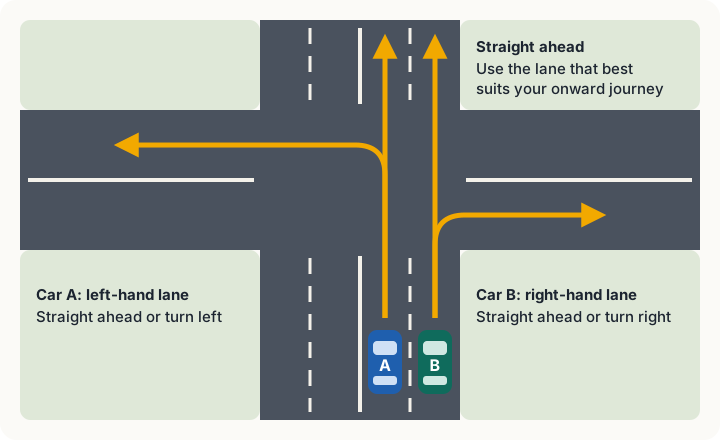
Fig. Figure 2.1Which lane for which direction. Original illustration, based on Handbook §2.1.1, p. 36
Which lane for which direction
Whatever you plan to do at the junction, choose your lane in plenty of time and avoid unnecessary lane changes by thinking ahead. The lane arrows painted on the road help you choose the correct lane.
Straight ahead: the lane best suited to your onward journey.
Turning right: the right-hand lane best suited to you.
Turning left: the left-hand lane best suited to you.
Source: Handbook §2.1.1, p. 36
Section 2 of 11
One-way traffic
On a one-way street everyone travels in the same direction, which changes where you position for a left turn.
Source: Handbook §2.1.2, p. 37
Definition
What one-way traffic means
One-way traffic means you can drive in one direction only.
The street is marked with the One-way traffic sign at the beginning of the block, and the sign applies until the next junction. To stop traffic entering in the wrong direction, a No Entry sign is posted at an appropriate point.
Source: Handbook §2.1.2, p. 37
Rule
Turning left from a one-way street
To turn left from a one-way street, keep as far to the left as possible. The handbook’s picture shows the car moving over to the left-hand side of the one-way street before it turns.
Source: Handbook §2.1.2, p. 37
Section 3 of 11
Roundabouts
Vehicles already on the roundabout have priority. Choose your lane early and signal right to leave.
Source: Handbook §2.1.3, p. 38
Illustrated
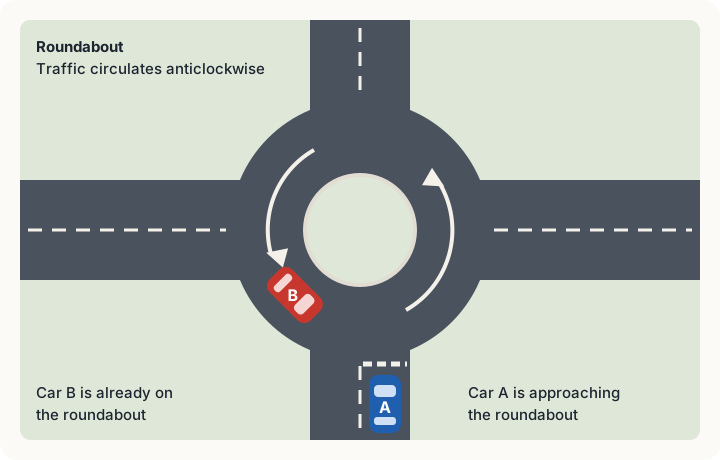
Fig. Figure 2.2Give way to vehicles on the roundabout. Original illustration, based on Handbook §2.1.3, p. 38
Give way to vehicles on the roundabout
All approaching vehicles must give way to those already on the roundabout. That priority is what greatly reduces the risk of a collision and makes junctions in light-traffic areas easier to enter.
The Give Way sign and the Roundabout sign together signal your obligation to give way. In the picture, car A waits for car B.
A roundabout is essentially no different from an ordinary crossroads, with one or more lanes encircling a central island. Think well ahead so that you do not have to stop or hesitate about where to turn off.
To turn right, get into the right-hand lane.
To turn left, move over into the left-hand lane.
Expect large or oversized vehicles to need more than one lane to turn.
Source: Handbook §2.1.3, p. 38
Rule
Leaving the roundabout
Always signal your intention to leave the roundabout by flashing your right-hand indicator.
The handbook tells you to maintain the same lane before, during and when exiting the roundabout. It also says that you may have to change lanes as you exit, and that it is then especially important to watch for vehicles coming up from the right.
Source: Handbook §2.1.3, p. 38
Rule
Same lane before and after a junction
When you approach a junction, maintain the same lane before and after crossing it. This is the same lane discipline the handbook asks for at a roundabout.
Source: Handbook §2.1.3, p. 38
Section 4 of 11
Using your eyes and other senses
Only a tiny part of what you see is sharp. Safe drivers keep their eyes moving and use both fields of vision.
Source: Handbook §2.2, pp. 39–40
Definition
The central visual field
The central visual field is the tiny area in which the image is actually in focus. It corresponds to the one spot on the retina where objects are seen sharply. Of everything we see, only 2 percent is in full focus.
Because everything else is blurred, it is essential to keep shifting your gaze so that you scan every part of the road ahead.
Source: Handbook §2.2.1, p. 39
Definition
Peripheral vision
Everything outside the central field is your peripheral vision, and it is more or less out of focus. Even with perfect eyesight, its sharpness is less than 0.1 on the acuity scale.
The two fields complement each other: peripheral vision lets you discover things, and central vision, where objects are in focus, lets you recognise them.
Source: Handbook §2.2.1, p. 39
Note
Scanning technique grows with experience
Scanning technique is how and when you read and interpret the road as you drive. It is crucial for spotting the conditions that could end in an accident, and tests show it develops as a driver gains experience.
Experienced drivers make better use of peripheral vision and scan the road more systematically.
Novice drivers tend to concentrate on stationary objects and keep their eyes close to their own vehicle.
Source: Handbook §2.2.1, p. 39
Important
Poor eyesight impairs your driving
Sharp vision and an unobstructed view are fundamental to correct decisions in complicated traffic. Your eyes provide 90% of all the information you need to manage your car in traffic, so any visual defect is likely to affect your driving.
Driving in the dark is especially hard on the eyes. Some drivers become short-sighted at night and may need corrective lenses. Others lose sharpness because their eyes become less sensitive to contrast, which is the ability to tell shades of grey apart.
Source: Handbook §2.2.2, p. 40
Section 5 of 11
Queuing in lanes
Pile-ups in queues come from driving too fast or too close. Looking further up the road prevents them.
Source: Handbook §2.3.1, p. 41
Rule
Look well ahead in a queue
In a queue, traffic jam or other congestion, collisions and pile-ups often happen simply because the vehicles involved were driving too fast, or were too close to brake in time.
Look well ahead and keep track of the vehicles further up the road. Their stop lights warn you when it is time to slow down, so it is easier to pick a suitable speed and you have more chance to react if you must stop in a hurry.
Source: Handbook §2.3.1, p. 41
Section 6 of 11
Changing lanes and passing in lanes
Change lanes only when it is safe and hinders nobody, never across a prohibitory line, and know when passing on the right is allowed.
Source: Handbook §2.3, pp. 41–42
Rule
When you may change lanes
You may change lanes only if you can do so safely and without causing any unnecessary hindrance to other road users.
Changing lanes constantly and without good reason is dangerous, and more so on fast roads. Speeding and failing to warn other drivers before a lane change cause many accidents. Frequent overtaking on both the right and the left confuses the traffic flow and is described as doubly dangerous.
Source: Handbook §2.3.2, p. 41
Rule
Help other drivers into your lane
If you see that another road user wishes to enter your lane, make it easier for them by adjusting your speed appropriately. The easiest way is to leave plenty of space between you and the vehicle ahead.
Source: Handbook §2.3.2, p. 41
Important
A prohibitory line means do not change lanes
A prohibitory line separating two lanes means that changing lanes is forbidden.
These lines are commonly found at junctions and on stretches of road where local conditions make lane changing unsuitable. If you need another lane, think ahead and move over well before the prohibitory line begins.
Source: Handbook §2.3.2, pp. 41–42
Rule
When passing on the right is permissible
In some cases you may pass another vehicle on the right without feeling that you are passing on the wrong side. The handbook lists these situations.
In congested traffic where the right lane is open.
Where the overhead signs above the lanes show that the lanes lead to different destinations.
Where drivers are keeping to their own correct lanes before negotiating a junction.
When the vehicle ahead has clearly indicated that it is about to turn left.
Source: Handbook §2.3.3, pp. 41–42
Steps
Changing lanes quickly, efficiently and safely
Plan ahead and choose your route wisely, so that each lane change is one you actually need. Then work through these steps.
1Adapt your speed to local conditions.
2Check the traffic all around. Use your mirrors, including the side mirror, and remember the blind spot.
3When the closest vehicle has drawn level, signal that you wish to change lanes and check how other drivers react.
4As you turn the wheel, check your side mirror and glance quickly over your shoulder again for vehicles hidden in the blind spot.
5Move smoothly over into the other lane, accelerating gently as you do so.
Source: Handbook §2.3.3, p. 42
Note
Signs above the lanes
The signs mounted above the lanes correspond to the lanes marked on the carriageway. Lane indication signs make it easier to select the correct lane in time.
Source: Handbook §2.3.3, p. 42
Section 7 of 11
Overtaking at junctions, bends and hills
Inside the city, overtaking is prohibited at junctions and wherever you cannot see the road, with one exception.
Source: Handbook §2.4.1, p. 43
Rule
Where overtaking is prohibited
The handbook names two kinds of place where you must not overtake.
Just before or while crossing a junction or intersection.
Where your view of the road is obstructed, such as at the brow of a hill or at a bend.
Source: Handbook §2.4.1, p. 43
Rule
The exception: a vehicle turning left
You may overtake if the vehicle ahead has clearly shown, both by a visual signal and by its position on the road, that it is about to turn left, and you overtake it on the right side.
Source: Handbook §2.4.1, p. 43
Section 8 of 11
Disabled pedestrians and children
Some pedestrians cannot protect themselves in traffic. The driver is the one expected to foresee the danger.
Source: Handbook §2.4, pp. 43–44
Rule
Elderly and disabled pedestrians
Disabilities may be visible, signalled or invisible. People with invisible disabilities are harder to recognise, so drivers often fail to show them the consideration they are due.
If you see someone you know or suspect to be challenged in any way, slow down in plenty of time and be prepared to give way.
Source: Handbook §2.4.2, p. 43
Important
A child is a living warning sign
Treat every child near the road as a living warning sign. The responsibility for making sure there is no accident is yours, because you are the one with the experience and the ability to foresee danger.
Children playing in or near the road may not be thinking about traffic at all. Watch out for the ball, then watch out for the child.
Source: Handbook §2.4.3, p. 44
Note
Why children are at risk in traffic
The handbook lists six things to remember about how children behave.
They are small and hard to see, for example when playing behind a parked car.
Their eyesight is not fully developed until around the age of fifteen, so they do not see things out of the corner of their eye.
They are impulsive and more often run than walk across the street.
They are always at play and understand little of the dangers of the road.
They do not become reasonable and safe in traffic until they are 9 to 12 years old.
They are poor judges of speed and distance.
Source: Handbook §2.4.3, p. 44
Note
School crossing patrols
School crossing patrols help school children cross busy, crowded streets on the way to and from school. A patrol also alerts drivers that there are children on the road.
Source: Handbook §2.4.3, p. 44
Section 9 of 11
Stopping and parking
Warn the drivers behind before you stop, know when stopping becomes waiting or parking, and secure the car when you leave it.
Source: Handbook §2.5, pp. 45–46
Important
Never stop abruptly or cut across
Many accidents happen because a vehicle stops abruptly without warning and the vehicle behind runs into it. Worse still is cutting sharply across another vehicle. Never cut across other vehicles suddenly, whether to turn or to pick up a passenger.
Besides giving the correct signal, it is advisable to press gently on the brake pedal several times. This alerts the drivers behind and gives them time to react.
Source: Handbook §2.5.1, p. 45
Rule
Stop or park on the right, never on the pavement
You may not stop or park in a way that creates a danger or obstructs traffic unnecessarily. As a general rule, stop or park on the right-hand side of the road. Stopping or parking on the pavement is strictly prohibited.
A halted vehicle can block other drivers’ view and force traffic towards or across the centre line. The more view it blocks, the greater the danger, particularly where traffic is fast.
Source: Handbook §2.5.2, p. 45
Important
Watch for doors on parked cars
Watch out for cars parked by the side of the road. If someone is inside, a door on the carriageway side could suddenly open just as you are passing.
Source: Handbook §2.5.2, p. 45
Definition
Stopping, waiting and parking
The three words describe three different states.
Stopped: as soon as you pull up.
Waiting: as long as you remain behind the wheel, with or without the engine running.
Parked: the moment you get out of the car after stopping.
Source: Handbook §2.5.2, p. 46
Steps
When you leave your vehicle
Three things to remember every time you leave the car.
1Never stop or park where you might cause an obstruction or be a danger to other vehicles.
2Make sure the handbrake is firmly on before you leave the car.
3Take the key out of the ignition and lock the car.
Source: Handbook §2.5.2, p. 46
Rule
Parking on a hill
On a slope, set the front wheels and the gear so that the car cannot roll away if the parking brake fails.
Downhill: turn the front wheels towards the curb, and leave the car in reverse gear rather than neutral.
Uphill: turn the front wheels to the opposite side, away from the curb, and leave the car in first gear rather than neutral.
Source: Handbook §2.5.2, p. 46
Section 10 of 11
Where stopping and parking are prohibited
Some places forbid even a brief stop; more forbid parking. Signs add further restrictions.
Source: Handbook §2.5.2, pp. 46–47
Rule
Places where stopping and waiting are prohibited
You may not stop or wait in these places. Naturally, you may not park there either.
Anywhere you might conceal a road sign or traffic light.
In an underpass or tunnel.
On, just before or just after a bend, or at the brow of a hill.
On roads or tracks reserved for pedestrians or cyclists.
In restricted areas.
At T-junctions.
Source: Handbook §2.5.2, p. 46
Rule
Check against current rules
Near junctions and pedestrian crossings
The handbook also prohibits stopping and waiting within 15 meters of a junction or crossing, or of a pedestrian crossing.
This distance is a legal figure from the October 2018 handbook and may have changed since. Check the current rule with your instructor.
Source: Handbook §2.5.2, p. 46Legal distance as printed in the 2018 handbook; not checked against current law.
Check against current rules. This point could not be fully verified or may have changed since the 2018 handbook.
Rule
Places where parking is prohibited
In addition to every place where stopping is prohibited, you may not park in these places.
Where you might hinder access to or exit from a building or site.
Alongside another parked vehicle, or alongside any equipment installed at the side of the road.
In front of a fire hydrant.
At any location reserved for disabled persons or for ambulances.
In an assigned parking space with any tyre touching or on the marking lines.
At a bus stop.
Source: Handbook §2.5.2, p. 47
Rule
No Stopping and Parking Prohibited signs
Signs can prohibit stopping or parking in places the general rules would otherwise allow.
No Stopping or Parking sign: stopping and parking are both strictly prohibited.
Parking Prohibited sign: you may stop to pick up or drop off passengers or goods, but you must do so without unnecessary delay.
Disabled Persons sign: only disabled persons holding special permits may park in the marked space or spaces.
Source: Handbook §2.5.2, p. 47
Section 11 of 11
U-turns and changing direction
U-turns are made from the left lane, giving way to all oncoming traffic. Any mishap is your responsibility.
Source: Handbook §2.5.3, p. 47
Rule
U-turns at junctions
Some junctions have provision for U-turns. Position the vehicle in the left lane and make the U-turn at the junction, remembering to give way to all oncoming traffic.
At junctions with traffic lights where U-turns are allowed, oncoming traffic will normally have a red light. Designated U-turn sites work in the same way. Even there, you still have to give way to all oncoming traffic.
Source: Handbook §2.5.3, p. 47
Rule
When a U-turn is permitted
Making a U-turn is only permitted from the left lane, and only if you can turn safely and without causing unnecessary hindrance to other road users.
Where traffic is heavy and fast, change direction at one of the designated U-turn sites, or keep going to a more suitable place further down the road.
Source: Handbook §2.5.4, p. 47
Rule
Turning around and reversing
If you find you are travelling in the wrong direction and have to turn around, do it at a place where other road users can see you clearly. The responsibility for any mishap will be entirely yours.
If you have to reverse, always reverse into the minor road, and watch out for children as you do.
Source: Handbook §2.5.4, p. 47
Chapter 2 recap
Remember this
Choose your lane in plenty of time, then keep to it and follow its marked course.
Right-hand lane to turn right, left-hand lane to turn left; on a one-way street, keep as far left as possible to turn left.
Approaching a roundabout, give way to vehicles already on it. Signal right to leave.
Peripheral vision discovers, central vision recognises. Keep your gaze moving.
A prohibitory line between lanes means do not change lanes, so move over early.
No overtaking just before or while crossing a junction, or where a hill or bend hides the road.
A child near the road is a living warning sign, and the responsibility is yours.
Behind the wheel you are waiting; once you get out you have parked.
U-turns only from the left lane, giving way to all oncoming traffic.
Common misconceptions
Myth
: If a straighter line through the junction is simpler, it is fine to take it.
Fact
: The handbook says the one sure way to avoid a collision is to keep to your lane and follow its course as marked, even when a straighter, simpler path looks more suitable.
Source: Handbook §2.1.1, p. 36
Myth
: Whoever reaches the roundabout first goes first.
Fact
: All approaching vehicles must give way to those already on the roundabout. The Give Way and Roundabout signs together signal that obligation.
Source: Handbook §2.1.3, p. 38
Myth
: With perfect eyesight I see the whole road sharply.
Fact
: Only about 2 percent of what you see is in full focus. Even with perfect eyesight, peripheral vision is blurred, which is why you must keep shifting your gaze.
Source: Handbook §2.2.1, p. 39
Myth
: Passing another vehicle on the right is always wrong.
Fact
: It is permissible in certain situations, for example in congested traffic where the right lane is open, or when the vehicle ahead has clearly indicated it is about to turn left.
Source: Handbook §2.3.3, p. 42
Myth
: I have only parked once I switch the engine off.
Fact
: The engine does not decide it. While you remain behind the wheel you are waiting, engine running or not. The moment you get out of the car you have parked.
Source: Handbook §2.5.2, p. 46
Myth
: At a signalled U-turn the oncoming traffic has a red light, so I do not need to give way.
Fact
: Oncoming traffic will normally have a red light, but the handbook still requires you to give way to all oncoming traffic when making a U-turn.
Source: Handbook §2.5.3, p. 47
Chapter 2 · practice
Check your knowledge
6 quick questions on this chapter, with an explanation after each answer. Or practise all 28 questions written for it.