How you think and feel behind the wheel matters as much as how well you handle the car. This chapter looks at maturity and responsibility, the personality traits and habits that lead to accidents, stress and group pressure, and the things that reduce your ability to drive: fatigue, illness, medicines, alcohol, drugs and distractions.
About 25 minutes
12 sections
Handbook Chapter 6, pp. 109–127
Chapter 6 · 12 sections
After this chapter you can
Describe the ego, rule and community stages and what a mature driver does differently.
Recognise impulsiveness, blaming others, repression and self-assertion in your own driving.
Explain how bad habits form through probability conditioning and imitation.
Explain what stress and group pressure are and how they change a driver’s behaviour.
Spot the stages of fatigue and know what to do when you are tired, ill or taking medicine.
Describe how alcohol and illegal drugs affect a driver.
Deal safely with phones, in-car equipment, children, passengers, food and smoking.
Section 1 of 12
Emotional maturity
Why young, inexperienced drivers have more accidents, and the three stages a person passes through on the way to mature driving.
Source: Handbook §6.1, pp. 109–110
Note
Why young drivers have more accidents
People aged 18 and over are assumed to be mature enough to drive safely and responsibly. The handbook says this is often far from the reality: young, inexperienced drivers are involved in far more accidents than older, more practised ones.
Driving means taking in a huge number of impressions at once and turning them quickly into decisions. A small mistake, such as slightly too much pressure on the accelerator, can push a driver beyond their capacity.
Novice drivers lack the experience to fully understand the traffic environment.
Many young drivers are not yet mature enough.
They have had less chance to learn their limits, so they make more driving errors.
Young people generally find it harder to put a mistake right.
Source: Handbook §6.1, p. 109
Definition
Ego stage, rule stage, community stage
The handbook describes three stages in developing a moral code of conduct. Many people, it says, never get past the first one and let it rule their driving.
Ego stage: like an infant, you think mainly of yourself and pay little attention to what others want or need.
Rule stage: you understand that society needs a set of rules, accept them and try to follow them.
Community stage: you respect and understand other people, are generous and tolerant, and know that human abilities are limited.
A driver at the community stage is not afraid to step aside to make things easier for others. Knowing the letter of the law is not enough; what matters is its spirit.
Source: Handbook §6.1.1, p. 110
Important
Immaturity and false role models
Immaturity makes accidents more frequent and often more severe. The handbook’s example is the immature young man who, without consciously thinking it, treats his car as a source of power that makes him tougher and more independent. That leads him into very dangerous situations.
Advertising, films and comic strips can blur the line between everyday reality and fantasy, where the hero always wins. Young people who believe they are invulnerable tend to disregard the risks they run in traffic.
Young drivers need to understand responsibility, tolerance and consideration for others.
Source: Handbook §6.1.2, p. 110
Section 2 of 12
Responsibility, identity and self-control
A responsible driver respects others, accepts the consequences of their own actions, stays in the real world and keeps their temper.
Source: Handbook §6.1.4, pp. 111–112
Rule
Responsibility: adapt to other people’s mistakes
A responsible attitude towards others goes hand in hand with maturity. You build it by learning from experience and by remembering that other road users can make mistakes too.
We have many rights, but also many obligations. Traffic would not flow if everyone drove by their own rules. The more consideration we show each other, the more smoothly and steadily it flows.
A safe driver is not irritated by other people’s mistakes; he adapts to them.
Responsible drivers respect others, follow the rules of the road and accept the consequences of their own actions.
Source: Handbook §6.1.4, p. 111
Important
Testing limits and playing the racing driver
Young people go through an experimental phase of testing how far they can go. On the road this often turns into testing what the car can do: taking a sharp bend at eighty, pulling out of a skid, or knocking a few minutes off a journey.
Predicting how a situation will develop takes experience, practice and maturity. A driver who roars along the highway or the Corniche as if he were a Formula 1 star, passing others as closely as he can, is playing a part he cannot handle, and he is doing it on a public road instead of a racetrack.
Source: Handbook §6.1.5, pp. 111–112
Rule
Keep your irritation under control
Self-control is part of maturity. In traffic it is vital not to let irritation get out of hand, even when you are quite justified in thinking another person’s driving is totally at fault.
Aggressiveness makes you a bad driver: it impairs your ability to assess the traffic around you.
It leads to unconsidered decisions and creates conflict with other drivers.
A good driver can stay alert and concentrated over a long period.
Daydreaming is a bad habit that lets your attention wander from the task of driving.
Source: Handbook §6.1.7, p. 112
Section 3 of 12
Know yourself and your driving skill
Drivers often misjudge their own ability. Experience changes how you scan the road, control the car and react.
Source: Handbook §6.1.8, pp. 113–114
Note
Overestimating your own skill
In a survey quoted by the handbook, young men who had held a licence for one to three years rated themselves as better-than-average drivers. Young women rated themselves as mediocre or below average.
The handbook concludes that young male drivers very probably overestimate their abilities to a considerable degree, pointing to the disproportionately high number of accidents involving young men. Their skills are simply not adequate for the speed at which they like to drive.
Source: Handbook §6.1.8, p. 113
Note
Experienced and inexperienced drivers compared
The handbook lists clear differences between seasoned drivers and novices.
Experienced drivers scan their surroundings more extensively and more systematically, and do not scan a right-hand curve the same way as a left-hand one.
Novices tend to treat all bends as more or less the same.
Experienced drivers recognise more potential hazards in moving traffic; novices tend to see the traffic environment as static.
Experienced drivers keep better control in a crisis, hold a more constant speed, accelerate less often and seldom brake in a panic.
Novices take longer to react in dangerous situations.
Young and inexperienced drivers generally drive faster and less smoothly, and are more inclined to be competitive.
Source: Handbook §6.1.9, p. 113
Note
Elderly drivers
Elderly drivers often have many years of experience, are critical of their own performance and are mostly courteous and considerate. They are usually no more dangerous than most other road users, and are seldom involved in single-vehicle accidents.
Physical changes with age do weaken performance, so elderly drivers must adapt their driving to their own physical abilities and to the traffic far more than younger drivers. If possible, they should avoid driving at night and in heavy traffic.
Source: Handbook §6.1.10, p. 114
Section 4 of 12
Personality traits that cause trouble
Impulsiveness, excuses, repression, reaction formation and the urge to assert yourself all raise the risk of an accident.
Source: Handbook §6.2, pp. 115–116
Definition
Impulsiveness: act first, think later
The impulsive personality acts first and thinks later. It is almost always out of place in traffic. Impulsiveness is often the same thing as foolhardiness: it alarms other road users and may cause the driver to lose control of the vehicle.
The handbook calls this behaviour typical of children, and merely dangerous in traffic.
Source: Handbook §6.2.1, p. 115
Important
Excuses: blaming others stops you improving
Some people feel a strong urge to blame others for their own mistakes and deny any responsibility. Because they never admit they were wrong, they see no reason to change how they drive, and they are likely to pick up very bad habits.
In the long term this is very dangerous, because it stops a novice developing as a driver and makes it much harder to learn from experience. To become a good driver you must acknowledge your own mistakes and accept that there is always room to improve.
Source: Handbook §6.2.2, p. 115
Definition
Repression: pushing the risk out of your mind
Repression means pushing unpleasant thoughts aside instead of seeing reality as it is. Deep down the driver knows the risk, but something else, such as getting home in time for the big match, seems more important at that moment.
Most drivers experience it now and then. It reduces your awareness of danger and increases your tendency to take risks, so the accident rate goes up.
Example: carrying on without slowing down in darkness and poor visibility.
Example: overtaking although you know the distance you can see is far too short.
Source: Handbook §6.2.3, p. 115
Definition
Reaction formation: doing the opposite of how you feel
A person can want to look boldly confident while feeling shy and deeply insecure. When one of these is exaggerated at the expense of the other, the insecurity shows up as aggressive rudeness, and the naturally timid try to show how bold they are.
This psychological defence mechanism is called reaction formation, and the handbook says it has caused many accidents.
Source: Handbook §6.2.4, p. 116
Important
Prestige and self-assertion
Some drivers assert themselves out of prestige: a feeling of superiority over other drivers and a belief that others should make way for them. Others feel compelled to show their passengers what exceptionally competent drivers they are.
Another form is insisting that you are right at all costs. No matter who is in the right, taking up the challenge and demanding an eye for an eye only makes you more likely to cause an accident.
Source: Handbook §6.2.5, p. 116
Section 5 of 12
Queue jumping and how bad habits form
Bad habits creep in when nothing goes wrong for a while, or when you copy the drivers around you without thinking.
Source: Handbook §6.2.7, pp. 117–118
Rule
Check against current rules
Do not jump the queue
Pushing past a queue on the left or right to reach the front, at signals or at a priority junction, inconveniences and endangers others. The 2018 handbook calls it a breach of the Traffic Law, a potential cause of accidents and a bad example, and says it points to a careless, aggressive personality.
Wait your turn. It is only a matter of a few seconds before you are moving again.
Source: Handbook §6.2.7, p. 117
Check against current rules. This point could not be fully verified or may have changed since the 2018 handbook.
Definition
Probability conditioning
You tend to adapt your driving to how often you expect something to happen. If you regularly pass a junction and seldom meet another car, you may stop slowing down for it. When a car does come, you do not stand a chance.
This kind of learning is called probability conditioning. It is insidious: it enters your subconscious without your knowing and can leave you with bad, even dangerous, habits.
Driving fast many times without an incident can "teach" you that high speed is not dangerous. It is.
Speed means risk, and risk leads to accidents.
Source: Handbook §6.2.8, p. 117
Note
Learning by imitation
Imitation can work for you or against you. Consciously copying your instructor’s smooth, safe driving brings good results. Copying other people without thinking leads to bad mistakes, and some habits picked up from a father or brother may need to be thoroughly revised.
The bigger risk comes after the test, when you see many bad driving styles and may forget what you were taught. The handbook’s advice: demand respect from other drivers, drive as you have been taught, and remember that no one can force you to adopt bad driving habits.
Source: Handbook §6.2.9, p. 118
Section 6 of 12
The will to learn and the need to learn
Knowing the rules and handling the car is only the surface. Real skill comes from in-depth learning and repetition.
Source: Handbook §6.3, pp. 119–120
Definition
Superficial learning and in-depth learning
All learning needs a positive attitude and an awareness of what has to be learnt. Believing that traffic skill is just knowing the rules and being able to manoeuvre a car is superficial learning, and it is not enough to make a good driver.
In-depth learning means experiencing many traffic situations and discussing and analysing them with your teacher, so that you understand the cooperation required of all road users and retain what you learn.
Do not just learn the rules by heart; reflect on the problems you and other drivers may meet.
The real goal is not only the licence but understanding traffic as a whole, staying alive and protecting others.
Source: Handbook §6.3.1, p. 119
Definition
Overlearning: practise until it is automatic
Overlearning means practising a new skill over and over, beyond the point of mastery, until it becomes automatic and driving is second nature.
Even after good training and a passed test, you should still regard yourself as a beginner who needs a great deal of practical experience before being reasonably safe. Many experienced drivers have found that the best way to avoid accidents is to take it easy on the road.
Source: Handbook §6.3.3, p. 120
Section 7 of 12
Focus on driving: distraction and stress
Keep your eyes on the road and your mind on the traffic, and avoid loading yourself with more than you can handle.
Source: Handbook §6.4, pp. 120–121
Rule
Do not try to do two things at once
Driving is basically about keeping your eyes on the road and watching out for other road users, on top of tracking signs, markings and hazards. Trying to do two things at once can be very risky, especially for young, inexperienced drivers: it is easy to lose control, and the less experience you have, the harder it is to get out of trouble.
Keep both hands on the wheel, your eyes on the road and your mind on the traffic.
The handbook’s examples of distractions: emotional problems, talking on a mobile phone, smoking and changing CDs.
Source: Handbook §6.4.1, p. 120
Definition
Stress
Stress is the result when the demands of the situation begin to exceed the ability of the driver. It turns mental energy into anxiety and irrational reactions, so the driver gradually loses focus on the goal of driving, which is to get from A to B safely. Sometimes it can even cause a blackout, a kind of mental short circuit.
No two people react to stress the same way; some tolerate a lot, others very little.
Everyone, especially young and inexperienced drivers, should avoid excessive levels of stress.
Tolerance builds up through practical driving experience and active learning.
Not all stress is negative: a certain degree can markedly improve your performance.
Source: Handbook §6.4.2, p. 121
Section 8 of 12
Group pressure
Passengers can push a driver into things they would never do alone. Notice it, and trust your own judgment.
Source: Handbook §6.5, p. 122
Definition
What group pressure is
Group pressure is the force that pushes a person to change their views in order to fall in with the wishes of others. The driver ends up attaching more importance to the passengers’ opinions than to his or her own judgment, and may do things he or she would normally never dream of doing, such as high speeds, hard acceleration and frightening overtaking.
Group pressure is not always negative. A group with sound values, expressed firmly but respectfully, can persuade someone to mend their ways.
This applies to the driver and to the passengers alike.
People with a stronger will and more ability to assert themselves resist negative demands better.
Source: Handbook §6.5.1, p. 122
Steps
Questions to ask yourself with friends in the car
With a group of friends on board you can be under much more pressure than when you drive alone. The handbook says it is important to note your own reactions.
1Has the way I drive been affected by the presence of my friends?
2Am I trying to impress them?
3Is their presence making me nervous?
4Am I afraid of making a fool of myself by doing something wrong?
Source: Handbook §6.5.1, p. 122
Section 9 of 12
Fatigue, illness and medicines
Tiredness builds in stages until sleep cannot be resisted. Illness and everyday medicines can also make you unfit to drive.
Source: Handbook §6.6, p. 123
Illustrated
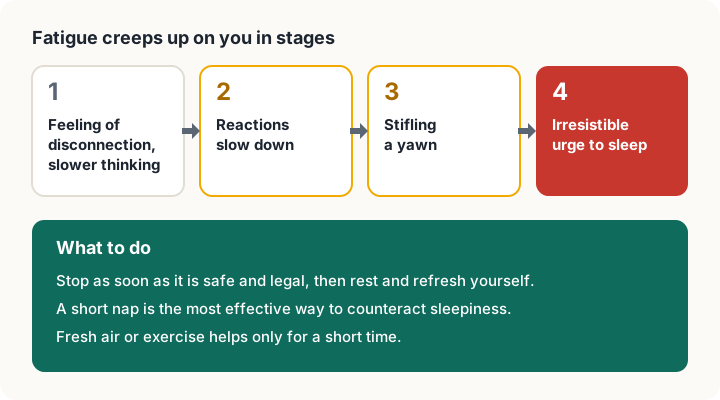
Fig. Figure 6.1The stages of fatigue. Original illustration, based on Handbook §6.6.1, p. 123
The stages of fatigue
Fatigue creeps up on you in stages. The first hint is usually a feeling of disconnection and a certain slowness of thought. Next, your reactions slow down. Soon you find yourself stifling a yawn. Before you know it, the urge to sleep has become irresistible and cannot be overcome.
Source: Handbook §6.6.1, p. 123
Note
Why driving makes you tired
Studies show that fatigue is responsible for a lot of motorway deaths. It is implicated less often in other types of accident but is still a prominent factor.
The most common reason for tiredness when driving is possibly the combination of physical exertion and monotony. Driving for a long period demands work from your muscles, and a busy, noisy road tires both your eyes and your ears.
Source: Handbook §6.6.1, p. 123
Steps
What to do when you are tired
Do not drive for too long without taking a break. However late you are going to be, it is never worth risking your life.
1Plan regular stops for rest and refreshment. This is especially important at night.
2If you are tired, stop as soon as it is safe and legal, and pull over at a safe place to rest and refresh yourself.
3If you cannot stop immediately, open a window to let in fresh air.
4Fresh air or exercise helps for a short time only.
5The most effective way to counteract sleepiness is a short nap.
Source: Handbook §6.6.1, p. 123
Rule
Illness and medicines
You must be medically fit to drive. If you are feeling tired, ill or unwell, do not drive: even a cold can make it unsafe. If you find you are losing concentration or not feeling well while driving, drop your speed and give yourself more time to react.
Some medicines should not be taken if you intend to drive. Even medicines for coughs and fever can make you drowsy.
Check any medicine you are taking to see whether it affects your ability to drive.
Read the information inside the packet, or consult your doctor or pharmacist.
Follow any recommendations you are given.
Source: Handbook §6.6.2, p. 123
Section 10 of 12
Alcohol and illegal drugs
If you drink, do not drive. Alcohol and drugs reduce your ability to drive safely, and the handbook says both carry legal consequences.
Source: Handbook §6.6, p. 124
Important
How alcohol affects your driving
If you drink, do not drive. If you drive, do not drink. Alcohol reduces your ability to drive safely, and driving with alcohol in your bloodstream is extremely dangerous.
Physical coordination and reactions are hampered by very small amounts of alcohol.
Most people claim a few drinks do not affect their eyesight. For the central field of vision that is true.
What they do not notice is the gradual deterioration of their peripheral vision. You remain unaware of what you cannot perceive until it is too late.
If you have already been drinking, the handbook’s suggestion is to take a taxi.
Source: Handbook §6.6.3, p. 124
Rule
Check against current rules
Alcohol: what the 2018 handbook says about the law
The handbook states that driving with alcohol in your bloodstream carries severe penalties if you are caught driving or attempting to drive while under the influence. It says that, under the law, any driver of a motor vehicle found to have a blood-alcohol content will lose their licence and be fined and/or sent to prison.
The chapter gives no fine amount and no numeric limit. This wording dates from October 2018, so check the current penalties with official sources.
Source: Handbook §6.6.3, p. 124
Check against current rules. This point could not be fully verified or may have changed since the 2018 handbook.
Note
Check against current rules
How long alcohol stays in your body
After a lot to drink, which the handbook puts at about 25 centilitres of spirit, it says your body will not be entirely free of alcohol until 12 to 15 hours after you stop. If the party ends after midnight, you may still be under the influence and unfit to drive the next morning.
The process cannot be hastened. The handbook gives an average of only around 2 centilitres of 40% spirit eliminated per hour, and warns that the figure may not apply exactly to you. Its advice: do not drive at all that day, or do not drink the night before.
Source: Handbook §6.6.3, p. 124The page’s beer and spirit equivalents do not agree with each other; figures reported as printed.
Check against current rules. This point could not be fully verified or may have changed since the 2018 handbook.
Important
Check against current rules
Illegal drugs
The handbook states that driving under the influence of illegal drugs is an offence. The effects of drugs are unpredictable, can be even more serious than those of alcohol, and may result in a fatal or serious road accident.
The handbook names no specific penalty. Check current official sources for the law as it stands today.
Source: Handbook §6.6.4, p. 124
Check against current rules. This point could not be fully verified or may have changed since the 2018 handbook.
Section 11 of 12
Distractions while driving
Driving needs your full attention. Phones, equipment, children, passengers, food and cigarettes all compete for it.
Source: Handbook §6.7, pp. 125–126
Note
What competes for your attention
When you drive you must give your full attention to the traffic and to what is happening around you. Any distraction can be dangerous. The handbook lists these.
Mobile phones and SMS.
Radio and music player.
Children in the car, friends and other passengers.
Eating while driving, and smoking while driving.
Finding the right road.
Driving a different vehicle.
Looking at things outside the road.
Source: Handbook §6.7.1, p. 125
Rule
Mobile phones: do not answer, do not text
Holding a phone in one hand and driving with the other is not safe, and trying to dial a number while driving is very dangerous indeed. A hands-free accessory makes calling somewhat less risky, though still not advisable.
If your phone rings, do not answer it. Wait until you can stop safely and then call back.
Never read a text message while driving. Typing one is even more dangerous.
Source: Handbook §6.7.1, pp. 125–126
Example
Why a phone call is not like talking to a passenger
When you chat with a passenger you automatically adjust the conversation to the traffic. If you stop talking to sort out a traffic problem, the passenger can see what is happening and keeps quiet.
The person on the other end of a phone call cannot see the road. If you suddenly stop talking, they are confused. Talking on a mobile phone while driving is therefore not at all the same as talking to a passenger.
Source: Handbook §6.7.1, p. 126
Rule
Check against current rules
Mobile phones: what the 2018 handbook says about the law
The handbook states that, under the Federal Law, you are not allowed to use a mobile phone while driving unless you are using a hands-free set.
It gives no penalty for this in the chapter. The statement dates from October 2018, so check the current rule and penalty with official sources.
Source: Handbook §6.7.1, p. 125
Check against current rules. This point could not be fully verified or may have changed since the 2018 handbook.
Rule
Radio, music player and GPS
Radios, GPS devices, music players and other equipment in the vehicle can distract you. Never try to set up or make complicated adjustments to any equipment while driving. Stop, and make the adjustments safely.
Source: Handbook §6.7.1, p. 126
Rule
Children, passengers, eating, drinking and smoking
Small children do not understand that you have to concentrate, and will try to get your attention even when you cannot help them.
If possible, have someone with you who can be responsible for small children while you drive.
Never let children move around in the vehicle. They should be seated and well secured in the special seats made for them.
Passengers should respect your need to concentrate. Do not allow them to intrude on your concentration.
Eating, drinking or smoking also takes your focus off the road. Stop and take a break rather than divide your attention.
Source: Handbook §6.7.1, p. 126
Section 12 of 12
Traffic offences and penalties
The handbook lists example offences and the kinds of penalty they can bring. It gives no amounts, and the law has changed since 2018.
Source: Handbook §6.8, p. 126
Note
Check against current rules
Examples of traffic offences in the 2018 handbook
The handbook says owners and drivers of motor vehicles, like other road users, can be punished for traffic violations and ordered to pay fines or compensation, or be sentenced to prison. It lists these examples of violations of the basic rules.
It gives no fine amounts and no black points, and this app does not add any. Check current official sources for today’s penalties.
Breaking the speed limit.
Driving through a red traffic light.
Having defective foot brakes or a defective exhaust system.
Failure to wear a seat belt.
Crossing a prohibitory line.
Disregarding a No Overtaking sign.
Stopping in a No Stopping area.
Parking on a marked bus stop or in a space reserved for disabled persons.
Source: Handbook §6.8, p. 126
Check against current rules. This point could not be fully verified or may have changed since the 2018 handbook.
Chapter 6 recap
Remember this
Ego stage, rule stage, community stage: a mature driver follows the spirit of the law, not only its letter.
A safe driver is not irritated by other people’s mistakes; he adapts to them.
Impulsiveness means acting first and thinking later, and it is out of place in traffic.
A quiet junction or an uneventful fast drive can teach you a dangerous habit: that is probability conditioning.
Stress starts when the demands of the situation exceed your ability.
Tired: stop when it is safe and legal. A short nap works best; fresh air helps only briefly.
Check every medicine before you drive. Even cough and fever medicines can make you drowsy.
If you drink, do not drive. Alcohol narrows your peripheral vision without your noticing.
Phone rings while driving: do not answer. Stop safely, then call back.
Common misconceptions
Myth
: Opening the window or stretching my legs will keep me awake for the rest of the trip.
Fact
: Fresh air or exercise can help for a short time but will not be effective for long. The most effective way to counteract sleepiness is a short nap.
Source: Handbook §6.6.1, p. 123
Myth
: A couple of drinks do not affect my eyesight.
Fact
: Central vision may seem unchanged, but peripheral vision gradually deteriorates, and you do not notice what you can no longer perceive until it is too late.
Source: Handbook §6.6.3, p. 124
Myth
: Talking on the phone while driving is no different from chatting with a passenger.
Fact
: A passenger sees the traffic and goes quiet when you need to concentrate. The person on the phone cannot see the road, so the handbook says the two are not at all the same.
Source: Handbook §6.7.1, p. 126
Myth
: I have driven fast many times and nothing has happened, so high speed is not really dangerous.
Fact
: That is probability conditioning: a habit learned because nothing has gone wrong yet. The handbook is blunt that high speeds are dangerous, that speed means risk and that risk leads to accidents.
Source: Handbook §6.2.8, p. 117
Myth
: Only strong prescription medicines matter for driving.
Fact
: Even medicines for coughs and fever can make you drowsy. Check any medicine you take, read the information in the packet or ask your doctor or pharmacist.
Source: Handbook §6.6.2, p. 123
Myth
: Once I have passed the test I am a safe driver.
Fact
: The handbook says you should still regard yourself as a beginner who needs a great deal of practical experience before you can consider yourself reasonably safe on the road.
Source: Handbook §6.3.3, p. 120
Chapter 6 · practice
Check your knowledge
6 quick questions on this chapter, with an explanation after each answer. Or practise all 13 questions written for it.